So Famous

http://krieger.jhu.edu/magazine/2012/04/rebuilding-the-foundation-of-science-education/

Posted in Uncategorized | Leave a comment

Famous

http://english.cntv.cn/program/general_news/20120513/103047.shtml

A news story about our course starts 18 minutes into this video from CCTV.

Posted in Uncategorized | Leave a comment

The End is Just the Beginning of Another Journey

“Coming together is a beginning; keeping together is progress; working together is success”

                                                                                                      ~Henry Ford

Macaulay 202: The room we spent endless afternoons in. Where we worked diligently in our bacteriophage projects, shared ideas and helped each other. This is the room where we came together as a group of students with the goal to learn from our professors and grow as individuals. The semester has come to an end and so has our time in the lab. Yet the spark of curiosity that this class ignited in me has not vanished but has lead me to challenge myself and explore new fields of research I had never considered such as Virology and Microbiology.

Before taking this class I was determined to go into human stem cell research, but after working with bacteriophages this semester – isolating plaques, seeing their structure and learning about their complex mechanisms – I was completely amazed and found myself wanting to know more about this subject. I recently wrote a research paper on the Influenza A (H1N1) virus for another class, and I felt satisfied knowing that I understood many of the techniques used to isolate a single virus that was used to make a vaccine. I feel that it is much easier to understand material you are given if you are familiar with the methods used, and this is one reason I love this class. This class has given me the freedom to explore questions that I want to explore as opposed to forcing me to learn material that the professor has chosen for me.

These last three weeks, I have been working on a foreign gene expression experiment. I am trying to discover the function of the protein expressed by gene product 44 of Manatee’s genome. I chose this gene product specifically because I found it intriguing to see the many HHPred hits it had with various types of DNA polymerases. I am very glad I chose this project because although I had no experience with any of the techniques needed to carry out this experiment, I have been able to learn most of them. I must confess at times I was not sure where this project was going to take me, much less to what conclusion I would come to, but we should take into consideration what Einstein once said “ If we knew what is was we were doing, it would not be called research, would it?” He’s right. This class has taught me to have a scientific plan but also learn to deal with obstacles such as contamination, imperfect dilutions, wrong annealing temperatures, mislabeling, and shortage of time. Although I will not finish my project in time, I did move far with it and will hopefully be able to complete in the next two weeks.

We came together in Macaulay 202, we worked together in the progress of our research projects and we were successful in accomplishing the goal of acquiring new knowledge. Thank You Professor Schildbach, Professor Fisher, Katy, Victoria, and the Phage Hunters for making this a great semester.

Posted in From the Phage Hunters | Leave a comment

How to define Phailure and Success

By Daniel Woods

As the end of the semester approaches, the phage hunters (some new and some old) are weeks into tackling the special projects that we proposed as the annotation of the genome came to a conclusion.  Some went the route of bioinformatics and decided to use a more technical and technology-based approach, while others, including myself, went back into the lab to perform experiments.  Now, these experiments ranged from testing out other phages for possible family relation to the A1 subcluster to finding more about Manatee, the phage we submitted, as well as the phages we isolated on our own.  As for myself, I tried to look into whether or not density seemed to affect certain plaque size and morphology of my isolated phage, Antiswag.  Perhaps there might be a subcluster of phages that contain a gene that controls such characteristics under specified conditions. And after weeks of tests and wacky results, I seem to have not been able to reach any sort of conclusion.  In other words, I have failed.

In other subjects, such as Mathematics, you are presented with a problem, and there is a methodical way to approach the correct answer and you are either right or wrong.  When you are wrong, you rework what you have done and the process repeats until the mistakes are fixed.  In relation to the lab, this seems to be the case as well.  There’s a methodical procedure in order to produce results that either support or go against your hypothesis.  But what happens when results from one week support while another week deny?  Have I failed in the methods and procedures such as in math?

Therein lies the beauty of the laboratory.  In reality, you cannot fail a laboratory or an experiment.  Granted, processes and procedures can be fine tuned to reduce the impact of the exterior environment, but after much preparation and training, this is hardly a factor.  Rather, the lab shows that evaluation of the results cannot definitively say whether or not you were successful or a failure.  Granted, results that support the hypothesis help indicate whether or not the proposed idea was true, but results that don’t support don’t necessarily negate the idea.  Rather, it begs a rephrasing or rethinking of the proposed idea, in order to adapt to the circumstances that are present.  Science does not fail the human thought, rather, it acts as a professor, leading the train of thought along the right tracks, hopefully arriving at the definitive answer.

After a full year of phage lab, I feel as if this is what I have to take away from it (besides the lab experience and knowledge).  There is no such thing as failure and it exists only if you view the process of rethinking that way.  If rethinking a problem is failure, then good luck in mathematics! But in reality, looking at results and conclusions no longer indicates that you “failed”, it just shows that you have to adapt to whatever your looking at has thrown at you.

Posted in From the Phage Hunters | Tagged , , , | Leave a comment

And back to the lab!

After 8 weeks of annotating our dear little Manatee’s genome and working incessantly on our computers we finally get to welcome back our beloved wet lab! Don’t get me wrong, I thought annotating the genome was an amazing experience and something few of us are lucky enough to get the chance to do, and I have learned so much more than I ever thought I would in this class. But I feel like I can speak for most of my fellow “phage lab mates” that what we all really love is the practical, hands-on work that our lab provides with the countless experiments we can do.

And this time it gets even better… we get to design our own experiment! It was hard to choose at first, but I knew one thing: that I wanted to once again work on my very own phage from last semester, Bwunder. It’s not everyday we get to name something, much less a virus, so I want to find out as much as I can about mine. In the end I decided to work alongside John, and we’re going to try to find out which phage cluster our little phages belong to.

Phages are grouped with those that are most closely related to each other, and these are called clusters (some even have sub-clusters). What we plan on doing is discovering which specific one our phages belong to. There are 16 different cluster primers available, and what we will be doing in the next couple of weeks is using the PCR (Polymerase Chain Reaction – which makes a huge number of copies of a gene) and “replicate” our phages DNA with each different primer – more specifically, one should work. We will then run them with gel electrophoresis and hope to get 15 failed reactions and one positive – which will be our cluster! Obviously there are chances of this not working, as they could belong to a different cluster or subcluster entirely or our DNA is not good enough, but hopefully we won’t have to worry about that.

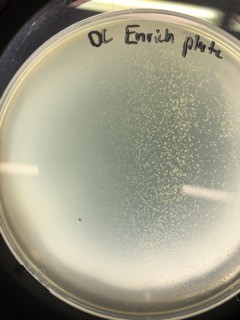
We will also take it one step further. My phage came from an enrichment, and my lab partner Ben’s phage, AverageJoe, came from that very same one. John has a similar case, as his phage, BugSlayer, came from Peter’s enrichment, which also yielded his phage, Boss. We will therefore carry out the same procedure on their phages so as to determine if our enrichments isolated two genetically similar phages (if both phages belong to the same clusters) or two phages that are totally different. We will then re-do the experiments to verify our results.

Hopefully all will go well with our experiments, but regardless I am happy to be back in the lab and excited to find out more about our phages. Everybody is now working on their own experiments, and it will be very interesting to see all the different results and new things we discover. And as for me, I hope to end this semester knowing exactly what cluster my little phage belongs to!

Posted in From the Phage Hunters | Tagged , , , , | Leave a comment

Phorever Phage Hunters

Although this semester of Phage Lab we had to deviate from the exciting and hands-on aspect of phage hunting, we still learned so much about another aspect of phage research. The purpose of the first half of this semester was to annotate Manatee’s (my phage that won the Phage Olympics last semester) genome. It took a little while for us to receive it, but a few weeks into the semester we finally received Manatee’s genome! For me it was such a rewarding and gratifying experience to actually see my phage’s genome mapped out in front of me after spending last semester isolating, purifying, getting plagued with unwarranted bacterial contaminations, and physically struggling to filter and isolate my phage’s DNA- sounds weird, I know, but trust me, it took some serious elbow grease to squeeze a liquid through a tiny little DNA-clogged filter using just a flimsy syringe.

At the beginning of the semester we had downloaded several programs to aid us in completing the annotation of Manatee’s DNA. My favorite program that we used was Phamerator. There are so many fun hidden features to this program, but the best I’ve seen yet Dr. Fisher and Dr. Schildbach showed us. With the click of a button all of these rainbow-colored bubbles magically appeared and floated across the screen landing on different genes (shown as colored blocks on the page) of the phages’ DNA that we were comparing. Specific colored bubbles represented individual “phamilies” of genes.

In addition to Phamerator, we annotated Manatee’s entire genome sequenced by the Howard Hughes Medical Institute using another program called DNAMaster. While this program didn’t quite have all the frivolous features of Phamerator, it excelled in practicality. Within a matter of weeks (it went by much quicker than I thought it would!) collectively as a class we annotated Manatee’s DNA in its entirety, all 51040 base pairs. Along the way we eliminated a few genes based on their lengths and many other qualifications including coding potential, Shine-Dalgarno sites, HHPred hits, and nucleotide blasts. HHPred allowed us to submit a specific gene sequence to be compared against all other phage DNA’s to find similar genes. Through this program we found out functions for a few of the genes like for example, a protein coding for capsids.

Although all of this genome annotating is fascinating I’m switching topics to explain my individual project. With a month and a half left in the semester our professors set us free to explore a phage-related topic of our choice. My partner-in-crime, Eleni, and I decided to vary the environmental conditions in which our phages typically grow in and observe and changes in growth. Both Manatee and Phido, Eve’s phage, came from the same soil sample on the Beach and I wanted to see if they reacted similarly of differently to the growth conditions I imposed on them. The results would hopefully provide me with a better understanding of the two phages and whether they are closely related.

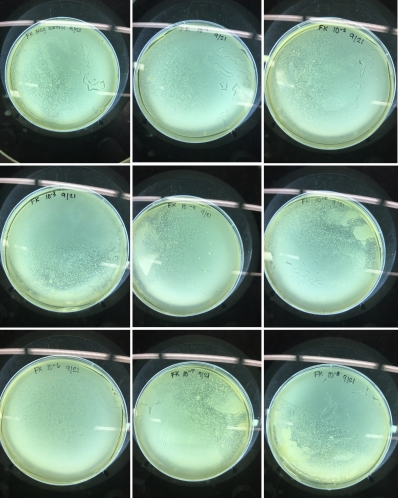
While I am still in the midst of experimenting, I have already gotten back results that I am really excited about! To start of the process I re-titered both Manatee and Phido so that I could recalculate their titers and make sure the high titer lysates had not degraded in the past months while we were doing the annotation work. Both titers were fairly similar to their original ones: success! Moving on, the first growth condition modification I made was temperature. I plated the dilution 10-7 3 times for both Manatee and Phido because in their titers, the 10-7 plate produced a countable number of plaques and then I placed one plate of each phage in an incubator set at 42 degrees Celsius, another at 37 degrees Celsius (the normal incubation temperature), and one plate each sitting out at room temperature. To my surprise, plaques grew on each plate! The main difference between the growth at the different temperatures was the carrying plaque sizes. At the lower temperature the plaques were smaller than the normal size and at 42 degrees Celsius the plaques were approximately 1-2 mm larger in diameter than normal. I repeated the same experiment and followed the same growing temperatures as before and plaque growth on the plate came back the same for both phages. Unfortunately, I do not know if the plaques are just physically larger or if there are more plaque forming units in the 42 degree Celsius plaques. To figure this out I must titer each of the plates that I tested in the temperature trials. Although this is tedious this will give me a better idea if the concentration of phage on the plates at the different temperature varied or if just the physical plaque size changed.

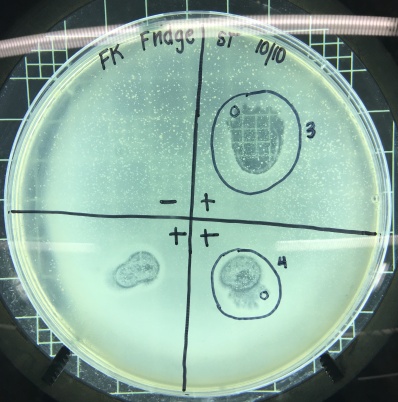
Another growth condition I am testing is calcium dependence. Usually we add a small amount of calcium to top agar before plating the phage-infected M. smegmatis. We’ve been told the calcium aids in phage growth, but I want to know if this is essential to the phage’s growth or if it’s superfluous. I plated the same 10-7 dilution with the usual amount of M. smegmatis but when adding the TA and plating it out, I used calcium enriched TA as a positive control and then used plain TA without any calcium to plate the other two plates for Manatee and Phido. The results came back and Manatee grew without any calcium! There were not any plates on either of Phido’s plates, even the positive control, so I must have done something wrong with the dilution.  Today in class I repeated this experiment to try to get consistent results for Manatee and to get decent results for Phido.

The final environmental test I plan to do involves drying out a sample of the 10-7 dilution of each phage then reconstituting it in phage buffer and finally plating it with the normal amount of bacteria. We are still working out the kinks of this experiment, but hopefully we will get interesting results! I have been very surprised with the results we have gotten thus far, and I cannot wait to pull together all of the observations and make conclusions about Manatee and Phido’s similarities. At the same time I am incredibly sad that a wonderful year in Phage Hunting is coming to an end. This class has truly been an amazing experience and I feel that all of the students, TA’s and professors have become a phamily: persevering through empty plates and frustrating contaminations, while also reveling  in the achievement of isolating a plaque and discovering new things about our phages. Cheers to a phantastic year of phage hunting!

Posted in From the Phage Hunters | Tagged , , | Leave a comment

How to Annotate a Genome

Second semester in Phage Hunting has been completely different from the fall. Last semester, we were in a standard biology lab every class, performing titer assays and streaks to isolate our own unique phage. I became the proud parent of AverageJoe! The highlight of my semester was the day I was finally able to see him for the first time on the electron microscope. As much as I loved him and wanted to keep working with him, I had to archive him and begin working on annotating Manatee’s genome for this semester. Since we came back to school in January, our lab became completely different; instead of wearing spiffy lab coats and plating bacteria, we sat in a circle with our laptops out and discussed different genes. Not your typical bio lab, right? It took me awhile to figure out how I could analyze start and stop codons, Shine-Dalgarno sequences, and blast hits to determine whether one of Manatee’s possible genes was in fact a true gene with a specific function, but with our professors’ and TAs’ help, I was analyzing genes in no time at all by the end.

Working on annotating a genome showed me a side of biology that I’d never been exposed to, but I was definitely glad when we found out that we would be able to go back to wet lab to work on our own independent projects. It took me awhile to figure out what kind of project I wanted to do, but after much deliberation, I decided to determine whether AverageJoe produced lysogens. I never thought that I’d be designing my own mini-research project as a freshman at a place like Hopkins, but I got to anyway! The Phage Hunting class has given me so much beneficial lab experience that I’ll be able to use to my advantage when I’m working on other research and lab projects as an upperclassman.

Posted in From the Phage Hunters | Tagged , , | Leave a comment